
How to structure a 15-second character short
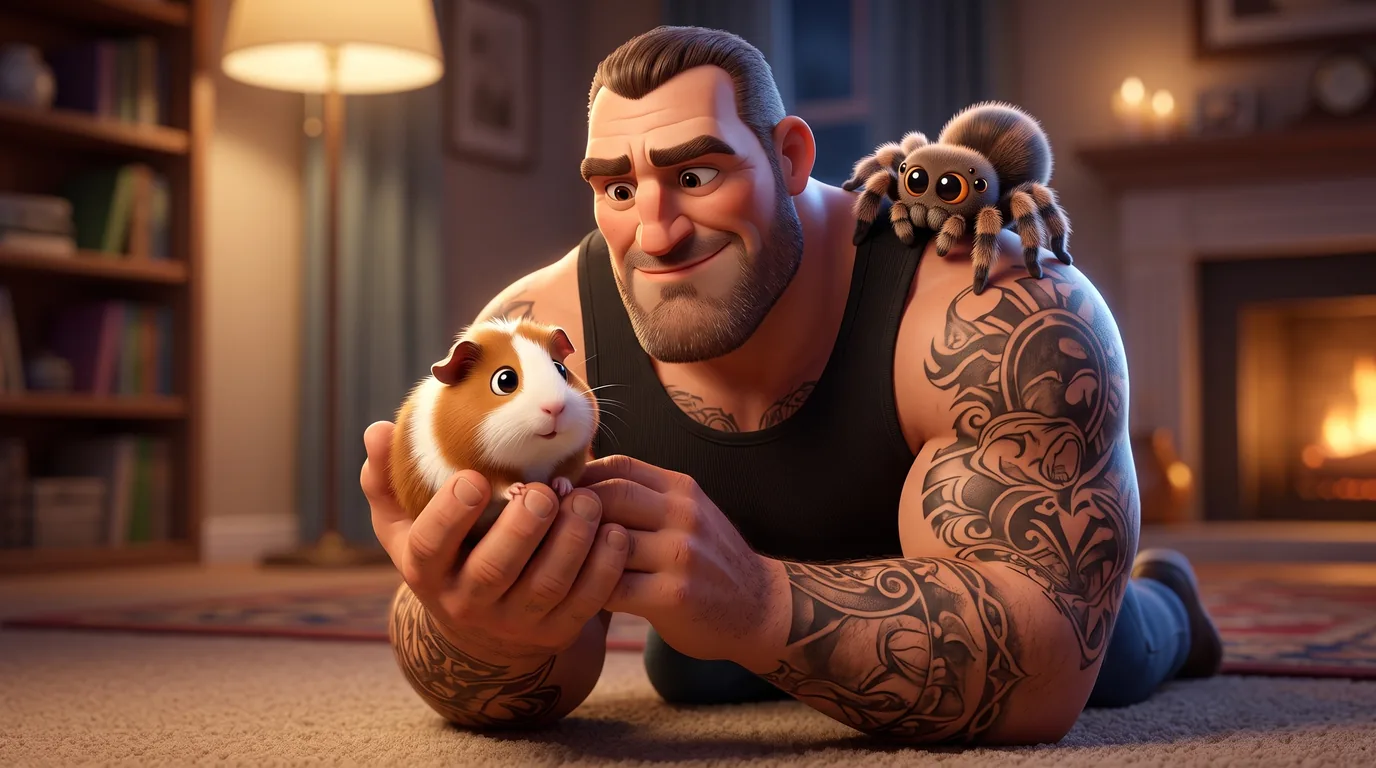
A short that works is five parts stacked together: a locked character description, a second-by-second beat sheet, one repeatable comedy engine, a few tight props, and a negative list — structure, not a single clever idea.
What actually goes into a 15-second character short?
It looks like one clever idea, but a short that works is really five parts stacked together: a cast the film can't let drift, a second-by-second beat sheet, one comedy engine it runs on, a few tight props, and a list of what must never happen. Our film 'The Tough Guy, the Tarantula & the Guinea Pig' is a good worked example — a muscular tattooed biker buys two tiny pets and completely melts, while the pets secretly become ridiculous rivals.
None of that structure is visible when you watch it, and that's the point. The structure is what lets fifteen seconds feel like a complete little story instead of a clip that just starts and stops. Knowing the five parts is how you tell a studio what you actually want — and how you can tell whether a short is built to work before it's ever made.
- A locked cast — every character pinned down so it looks identical in every shot.
- A beat sheet — the fifteen seconds divided into timed moments, one action each.
- One comedy engine — a single joke the film can repeat and escalate.
- Tight props — a few objects the story happens around, not a cluttered set.
- A negative list — the wrong version, named, so the film never drifts toward it.
How do you keep the character looking the same the whole way through?
This is the first thing that separates a real short from an AI clip that falls apart. In our prompt the man isn't described once and left alone — his features are pinned in a list (broad muscular build, tattooed arms and neck, trimmed beard, black tank top, chunky boots) and then locked with a flat instruction: keep him identical throughout — same face, same tattoos, same outfit, same body proportions. Each pet gets the same treatment.
We call it the identity lock, and it exists because a character's look is the one thing an audience notices the instant it slips. If the tattoos move or the guinea pig changes colour between shots, the film stops being about a character and starts being about the glitch. A short lives or dies on the cast staying recognisably itself, so the description does the boring work of nailing every feature down and repeating 'keep identical' out loud.
- List the fixed features — build, hair, clothing, colours — don't just name the character.
- Say 'keep identical throughout' explicitly; the model will not assume it.
- Lock every recurring character, not just the hero — a drifting pet breaks it too.
How do you fit a real story into fifteen seconds?
You budget the seconds like money. Our prompt is a beat sheet: a fast setup from 0.0 to about 2.5 seconds (the man walks in, melts, buys both pets), a repeating middle from 2.5 to 12.5, and a comedy button at the end from 12.5 to 15. Inside that, every beat is tiny and specific — '2.9–3.4: the man turns away, the tarantula darts for the treat, the guinea pig tackles him' — one clear action per slice.
The shape matters more than the exact numbers. Set up fast, because fifteen seconds has no room for a slow start. Spend the middle on the thing the film is actually about. End on a button — a final beat that lands the joke — so it finishes instead of just stopping. When a short feels rushed, or feels empty, it is almost always the beat budget that's wrong, not the idea.
- Set up in about 2.5s, spend the middle on the heart, close on a button.
- One action per beat; if a beat needs two sentences to describe, it's two beats.
- Timecodes keep the pacing honest — they are a budget, not decoration.
What actually makes it funny?
One engine, run four times. The whole film turns on a single rule: when the man looks at the pets, they freeze into innocent little angels; the moment he looks away, they fight; the instant he turns back, they snap to sweet again. That's the engine. The prompt even states it twice so the model can't forget it — 'the innocence is fake and funny', 'no halos, no magical good-pet effects'.
Then it just repeats that engine with escalating props: a treat bowl, then a single berry, then a cushion, then a shared blanket bed. Same joke, bigger stakes each time. This is the part most people get wrong — they try to pack in four different jokes, and four different jokes in fifteen seconds is noise. One joke the audience learns in the first five seconds and then gets to anticipate is what actually makes a short land.
- Find one mechanism the film runs on and make it a rule the whole thing obeys.
- Repeat it with variation — new prop, higher stakes — not four unrelated gags.
- A joke the viewer can predict is funnier than one they can't keep up with.
Why does the prompt spend so long on what NOT to do?
Because a model has defaults, and its defaults are your failure modes. Ask for a tarantula and its first instinct is a realistic, slightly frightening one — the opposite of a cute pet comedy. So the prompt carries a negative list: no horror spider visuals, no realistic frightening tarantula, no gore, no animal injury, no identity drift, no text on screen. Each line is a wrong version, named, so the film is steered away from it.
Negatives are not padding. Nearly every one is a mistake someone already generated and had to throw away. Naming the wrong outcome is often more powerful than describing the right one, because it blocks the specific place the model wants to wander off to. The 'no text on screen' line earns its place every time — models cannot spell, and gibberish lettering ruins an otherwise clean frame.
- Name the wrong version — 'no scary realistic spider' — not only the right one.
- Negatives block the model's defaults, which are usually the failure you'd get.
- 'No text on screen' is almost always worth including — models can't spell.
So what do you actually need to bring?
Not this. You don't write a beat sheet or a negative list — that's the studio's job, and it's most of the craft. What you bring is smaller and more valuable: the character you want people to remember, the one running joke or feeling the film is about, and the single detail that must be exactly right. We turn that into the locked cast, the timed beats, and the negatives.
If you can describe your character in a sentence, and the one thing it does that's funny or endearing, you have enough to start. The structure on this page is what we build around it — knowing it exists is mostly so you can tell a built short from a clip, and brief for your first one instead of your third.
Common questions
How long should a character short be?
Around fifteen seconds for social. It's long enough to set up a character, run one joke a few times, and land an ending — and short enough to hold attention. The discipline is fitting a complete beginning, middle and end into that window.
What is an 'identity lock' in a video prompt?
A fixed, listed description of each character — build, hair, clothing, colours — plus an explicit instruction to keep it identical in every shot. It's what stops a character's look drifting between beats, which is the most noticeable AI-video failure.
Why does a short use the same joke over and over?
Because one joke, repeated with escalating stakes, is easier to follow and funnier than four different ones crammed into fifteen seconds. The audience learns the rule early and then enjoys anticipating it. Repetition with variation is the engine, not a shortcut.
Do I need to write the prompt myself?
No. You bring the character, the one running joke, and the single detail that must be right. The studio writes the beat sheet, locks the identity and sets the negatives. Knowing the structure just helps you brief it well.